This article contains affiliate links. If you buy through them, we may earn a commission at no extra cost to you. Learn more.
Quick Start
Your new IPTV service can be up and running in under an hour. Follow four practical steps — choose a provider, save credentials, install the right app, verify — no technical background needed.
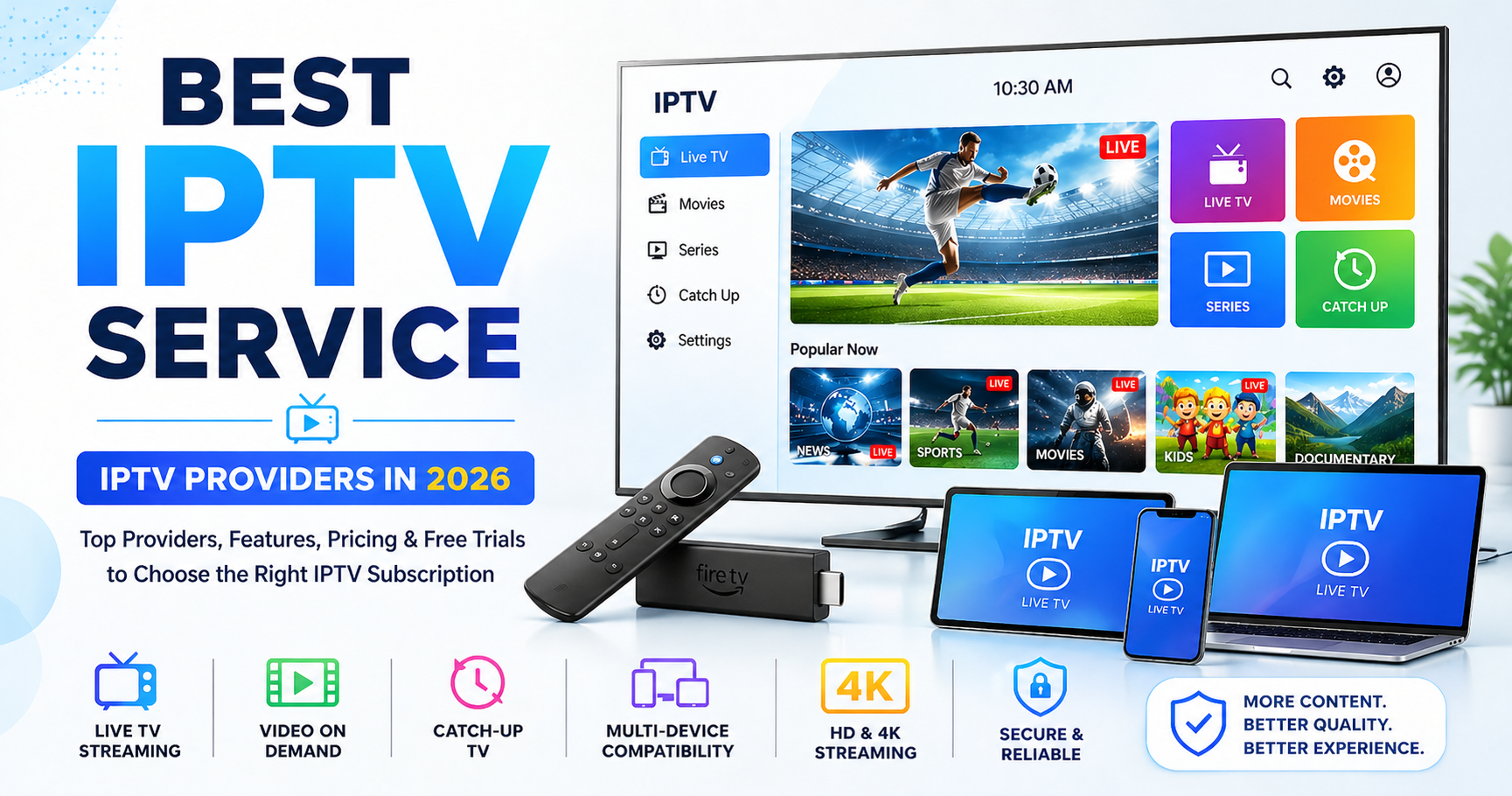
In Brief
- IPTV setup is four steps — choose a service, save credentials, install a player, verify — and takes roughly 30 minutes.
- The player app (TiviMate, IPTV Smarters Pro, or VLC) shapes your daily experience more than the service branding does.
- A trustworthy provider offers a trial or monthly plan, gives you M3U/Xtream Codes, and answers the licensing question directly.
- Most buffering comes from home-network issues and app settings — not from the subscription — so start monthly and test before paying yearly.
In This Guide
- What Your Finished IPTV Setup Looks Like
- What You Need Before Starting
- Step 1: Choose a Service You Can Trust
- Step 2: Sign Up and Protect Your Credentials
- Step 3: Install the Player App on Your Device
- Pros and Cons of IPTV Services
- Step 4: Verify Everything and Optimize
- Troubleshooting Setup Problems
- All IPTV Setup Steps at a Glance
- Which IPTV Service Should You Start With?
- Frequently Asked Questions
If you can install an app on your phone, you can get an iptv service running on your television. The process is mostly login forms, one playlist URL, and a few minutes of clicking through app-store menus. What trips most first-timers isn't the technical part — it's the fragmentation. Providers hand you credentials in different formats, player apps all look slightly different, and the YouTube tutorials you find are often outdated or start halfway through. This guide cuts through that noise with a four-step path from zero to watching: choose a service, save your credentials, install the right player app, and verify the setup end to end.
What Your Finished IPTV Setup Looks Like
By the end of this guide, you'll have a working IPTV setup on the device you actually watch TV on — Fire Stick, Android TV box, smart TV, tablet, or phone. Concretely, that means your subscription's login details stored somewhere safe; a player app installed that can read those details; the electronic program guide loaded so you can see what's on; and a channel list, video-on-demand library, and catch-up folder you can navigate without help. You'll also know what to check when a stream glitches — because at some point it will, and that's normal.
What You Need Before Starting
Three things, and none of them are technical:
- A device with an app store — a Fire Stick, Android TV box, a recent smart TV, or a tablet.
- A broadband connection that streams reliably. For HD channels, plan on a sustained download speed of roughly 25 Mbps. If your TV is far from the router, expect buffering no matter what the speed test says.
- An active subscription from an IPTV provider. Most send you either a long M3U playlist link or three "Xtream Codes" fields: server URL, username, and password.
The one thing people forget: keep your welcome email accessible during setup. You will need those credentials on the same screen as your TV.
Step 1: Choose an IPTV Service You Can Trust
Start by writing down your must-haves: which devices you'll watch on, which countries' channels actually matter, and whether you need catch-up TV for time-shifted viewing. Then use that list to shortlist providers. Community threads — the "iptv service review reddit" posts and similar forum conversations — tend to be more honest than ads, because real subscribers mention buffering, support response times, and channel counts in passing.
Ask any candidate these four questions before paying:
- Which apps does this work with? You want a service that exposes an M3U playlist or Xtream Codes, not one that locks you into a proprietary app.
- Do you offer a trial or a single-month plan? A provider that refuses a short-term plan is showing you how they'll treat you later.
- What's the EPG and catch-up situation? Gaps here will annoy you on day two, when the program guide is empty.
- Is the content properly licensed? Walk away if the answer isn't straightforward. Grey-market services can disappear overnight — along with your prepayment.
Which payment length should you choose? An iptv service monthly subscription vs yearly comparison nearly always ends the same way: start monthly. It costs a little more per month, but it protects you during the period when most problems show up — the first 30 days. Yearly plans look attractive on paper, and many sellers push them because recurring customers are work for them, not profit. Upgrade only after you've had two or three stable months.
| Plan type | Typical price per month | Commitment | Best for |
|---|---|---|---|
| Monthly | Highest per month | 1 month | First-time setup; low-risk trial of a provider |
| Quarterly | Middle price | 3 months | Short-term use, such as a sports season or holiday stay |
| Yearly | Lowest per month | 12 months | A proven provider you've already used for at least two months |
Many providers also discount the first month or add free months to a yearly plan — read the offer details before paying, and keep a screenshot of what was promised.
Step 2: Sign Up and Protect Your Credentials
Once you've chosen a provider, sign-up is usually instant: pay, check your email, and open the welcome message. That message contains either a long web address ending in .m3u (the M3U playlist URL) or three separate Xtream Codes fields: server URL, username, and password. Some providers send both. Some also require an account-activation click before your subscription starts working.
Common mistakes at this step:
- Forgetting the welcome email is in spam. Search your spam folder before emailing support.
- Copying only part of the M3U URL. Long links wrap across lines in mail apps — scroll all the way to the end.
- Sharing your login "just to check it works." Most providers allow one or two simultaneous connections; a sudden "account already in use" error usually means someone else is on it.
Save the credentials in a password manager, and also keep a plain-text copy somewhere you can reach from your TV device. The second copy sounds redundant until you're standing in front of a Fire Stick with a phone that's dead.
Step 3: Install the Player App on Your Device
The player app is the interface you'll live in, so it matters more than the service logo. The three most commonly recommended apps for IPTV beginners:
- TiviMate — Android / Fire Stick. The best-looking program guide, favorites, and catch-up support. This is where most IPTV enthusiasts end up.
- IPTV Smarters Pro — available on nearly every platform. The friendliest first app, though the interface feels busier than TiviMate.
- VLC — not a dedicated IPTV player, but it plays an M3U URL immediately. Handy for testing a new subscription on a laptop or phone before you touch the TV.
For Fire Stick and Android TV, open the app store, search for one of those names, and install. On some Android boxes, the Google Play Store isn't preinstalled; sideloading APKs through the Downloader app works, but only install apps whose source you trust. Smart TV owners face a thinner choice: Samsung and LG stores carry a handful of IPTV players, and if yours doesn't, the standard workaround is a $20–$30 Fire Stick or Android dongle — it immediately opens the full TiviMate experience.
After installation, open the app and look for "Add Playlist" or "Sign in." Paste the M3U URL or fill in the three Xtream fields, then let the app sync. The truth is that most IPTV problems are not caused by the stream itself at all — they come from a misconfigured app, a typo in the login details, or a network that isn't up to the job. If the app freezes during the first sync, force-close and retry; the playlist can take a moment to download on slower connections.
Most IPTV problems are not caused by the stream itself but by a misconfigured app, an unstable network, or a typo in the login details.
Pros and Cons of IPTV Services
IPTV has a real upside and a real downside, and acknowledging both makes setup easier — you'll know what to worry about and what to ignore.
| Pros | Cons |
|---|---|
| Runs on almost any device with a screen and an internet connection. | Quality varies considerably between providers — trial before you trust. |
| Live TV, catch-up, and video-on-demand sit in one interface. | Support is often informal; many sellers are one-person resellers. |
| International channel packages are hard to match on traditional cable. | Some services are grey-market — verify the content licensing story. |
| Monthly plans are affordable and give you flexibility. | Buffering may persist if your home network can't sustain the stream. |
Step 4: Verify Everything and Optimize
Loading the channel list isn't the finish line. A clean, reliable setup takes four quick checks:
- EPG loads. Open the program guide and confirm it's showing what's on now — not empty boxes. If it's empty, refresh the EPG in the app settings and check the time-zone setting if you're outside a default region.
- Catch-up works. Pick a channel with catch-up marks in the guide and start a program that began 20–30 minutes ago. It should start from the beginning.
- Channel groups are organized. You should see folders like Sports, Documentaries, or country names. If some groups are missing, the service's playlist may need a refresh in the app.
- No buffering during the first minutes. If the stream glitches immediately, your network is the first suspect — try a wired connection on the Fire Stick before blaming the provider.
Two optimization tricks that improve daily use: set a longer buffer size if your app offers it (in TiviMate, it's under the playback settings), and use your provider's dedicated EPG URL if they publish one for your region. Also sort channels into a favorites list the moment you find channels you watch often — it turns the app into something that feels like cable rather than a firehose.
Troubleshooting: What to Do If Something Goes Wrong
These five issues account for most beginner frustration:
- Buffering. Run two checks: a speed test on the same device, and a test with the app's resolution set to 1080p instead of 4K. When people ask for "the best iptv service no buffering," the honest answer is that a wired network and realistic video settings fix more buffering than any provider swap.
- "Account already in use." Either another person is on the line, or the provider flagged a login change. Log out of all devices if you can, then log back in; if the error persists, write to support.
- EPG blank on some channels. Give the EPG an hour and refresh — some services populate guide data slowly.
- A channel won't play at all. Select the channel, wait ten seconds, and try again. If it's still dead, test another channel to confirm it's a service-side issue rather than a device problem.
- "Playlist expired" on a paid plan. The provider may have rotated your credentials. Check the welcome email for updated M3U or Xtream details, or request them by email.
All IPTV Setup Steps at a Glance
| Step | What to do | Time needed | Pitfall to avoid |
|---|---|---|---|
| 1 — Choose a service | Shortlist providers with M3U/Xtream support, EPG, catch-up, and a trial | 5–10 min | Prepaying yearly before a trial |
| 2 — Sign up | Save the M3U URL and/or Xtream Codes in two places | 5 min | Losing the welcome email to spam or sharing your login |
| 3 — Install the player | Install TiviMate, IPTV Smarters Pro, or VLC from a trusted app store | 10–15 min | Sideloading unknown APK files |
| 4 — Verify and tune | Refresh EPG, test catch-up, set buffer size, watch one channel for 5 minutes | 5–10 min | Blaming the provider when the network is the issue |
Where to Buy
Compare package options and check what the current offer includes before you decide.

Which IPTV Service Should You Start With?
If you'd rather not shortlist ten providers, the service featured throughout this article is the closest match to what we'd look for in a first IPTV subscription: it advertises M3U and Xtream Codes support — so you keep control over the player app — plus catch-up TV, EPG coverage, and a monthly plan rather than a forced year-long commitment. You can see the provider's current plan options on its official page, and then run the exact four steps above without any changes. Everything in this guide applies directly to it.
The Bottom Line
An IPTV service is only as good as its setup path, and this four-step route — choose, save, install, verify — is realistic for any beginner. Start with a monthly subscription from the provider featured in this guide; it clears the same gates we'd check for any service, and you can be watching within half an hour.
link oneThis link goes to the seller's official checkout. If you purchase through it, we may earn a commission at no additional cost to you. Our assessment is written independently of that arrangement.
Frequently Asked Questions
What is the best iptv service for firestick?
The best IPTV service for Fire Stick is the one that pairs well with a player app you like and offers a reliable EPG, catch-up, and network stability. Search results for "best iptv service for firestick 2025" and similar queries usually surface the same handful of names, because the app ecosystem hasn't changed much year to year — what matters is matching the service to your channels and your internet connection. A monthly plan is the only honest "best" option before you've tested a provider for at least a few weeks.
How do I set up an iptv service on my smart TV?
Install a player app from your TV's app store. On Samsung and LG smart TVs, IPTV Smarters Pro and similar players are available in many regions; search for "IPTV" in the TV store and you'll usually find at least one compatible app. If your TV's store doesn't have one, the practical workaround is to plug in a Fire Stick or an Android TV device and run the same setup steps from this guide. The credentials you save in Step 2 carry over to whichever device you settle on.
Is IPTV legal?
IPTV is a neutral way of delivering video over the internet — the same technology that powers on-demand services. What matters is whether the provider actually has the rights to the channels it sells. Legitimate resellers exist, but grey-market providers do too, and they can disappear without notice. If a seller is vague about content licensing, offers no trial, and demands yearly prepayment, treat that as a clear red flag.
Where can I buy a reliable iptv service?
Start in community spaces rather than ad pages. Reddit threads like "iptv service review reddit" often describe the day-to-day reality of specific providers — buffering, support speed, and whether the provider survives after a few months. A reliable service normally offers a trial, supports M3U and Xtream Codes, and doesn't require a full year upfront. The provider featured in this guide is one of the services that follows that pattern.
Why does my iptv service keep buffering?
Buffering usually points to your network rather than the subscription. Run a speed test on the same device running the IPTV app and compare the results to what the channel needs — around 25 Mbps for a stable HD stream is a reasonable target. Try lowering the stream quality inside the player app from 4K to 1080p and see whether buffering disappears. If the stream is worse during peak evening hours, your ISP may be throttling traffic; a VPN is the common workaround.
Should I choose an iptv service monthly subscription or yearly plan?
Start with a monthly subscription, always. An iptv service monthly subscription vs yearly plan comparison looks attractive on paper because the per-month price drops sharply on annual plans, but you're trusting a provider that may stop operating or change its lineup. Monthly lets you verify EPG, catch-up, buffering, and support quality with minimal exposure. If everything is stable after two or three months, then consider paying quarterly or yearly.
What is the best iptv service for international channels?
International channel lineups vary wildly between providers, so never assume a service covers every country. Ask the seller for a full channel list before you pay and check that the specific countries and language groups you follow are present. A short trial with a monthly plan gives you time to scan the playlist folder by folder. Also check whether international channels are included in the base plan or require a separate add-on.
How do I find an iptv service with catch-up TV?
Look for providers that support Xtream Codes, because catch-up TV is usually implemented through that format rather than a plain M3U list. If you're searching for an affordable iptv service with catch up tv, filter for providers that include the feature in their base subscription — many reserve it for higher tiers. During a trial, open a channel that shows a clock icon in the EPG and start a program that began half an hour ago; if the stream starts from the beginning, catch-up is genuinely working.
Disclosure: Some links in this article are affiliate links, meaning we may earn a commission if you make a purchase — at no additional cost to you. This does not influence our editorial assessment, which is based on publicly available information about the product.